
India is still early in its fitness journey. Only about 0.8% of Indian adults hold a fitness facility membership, yet the market is projected to more than double by 2030 (Deloitte–HFA, 2025). That combination of low penetration and steady growth is why gyms keep attracting first-time entrepreneurs. A good plan is what separates a gym that fills up from one that struggles to cover its rent.
Key takeaways
- A gym business plan should answer five questions: who your members are, where you’ll open, what it will cost, how you’ll earn and when you’ll break even.
- Value gyms account for about 78% of memberships in India, while boutique studios are the fastest-growing segment at nearly 19% a year (Deloitte–HFA, 2025).
- Typical registrations include a business entity, Shops and Establishments registration, a municipal health or trade licence, fire NOC, GST and music licences. Rules vary by state and city.
- GST on gym services was reduced from 18% to 5% from 22 September 2025.
- Break-even members = monthly fixed costs ÷ average monthly revenue per member.
What should a gym business plan include?
A gym business plan should cover your market, location, gym format, investment, revenue model, operating costs, marketing, staffing and financial projections, including the number of members you need to break even. Lenders, landlords and franchise partners will all ask for these numbers.
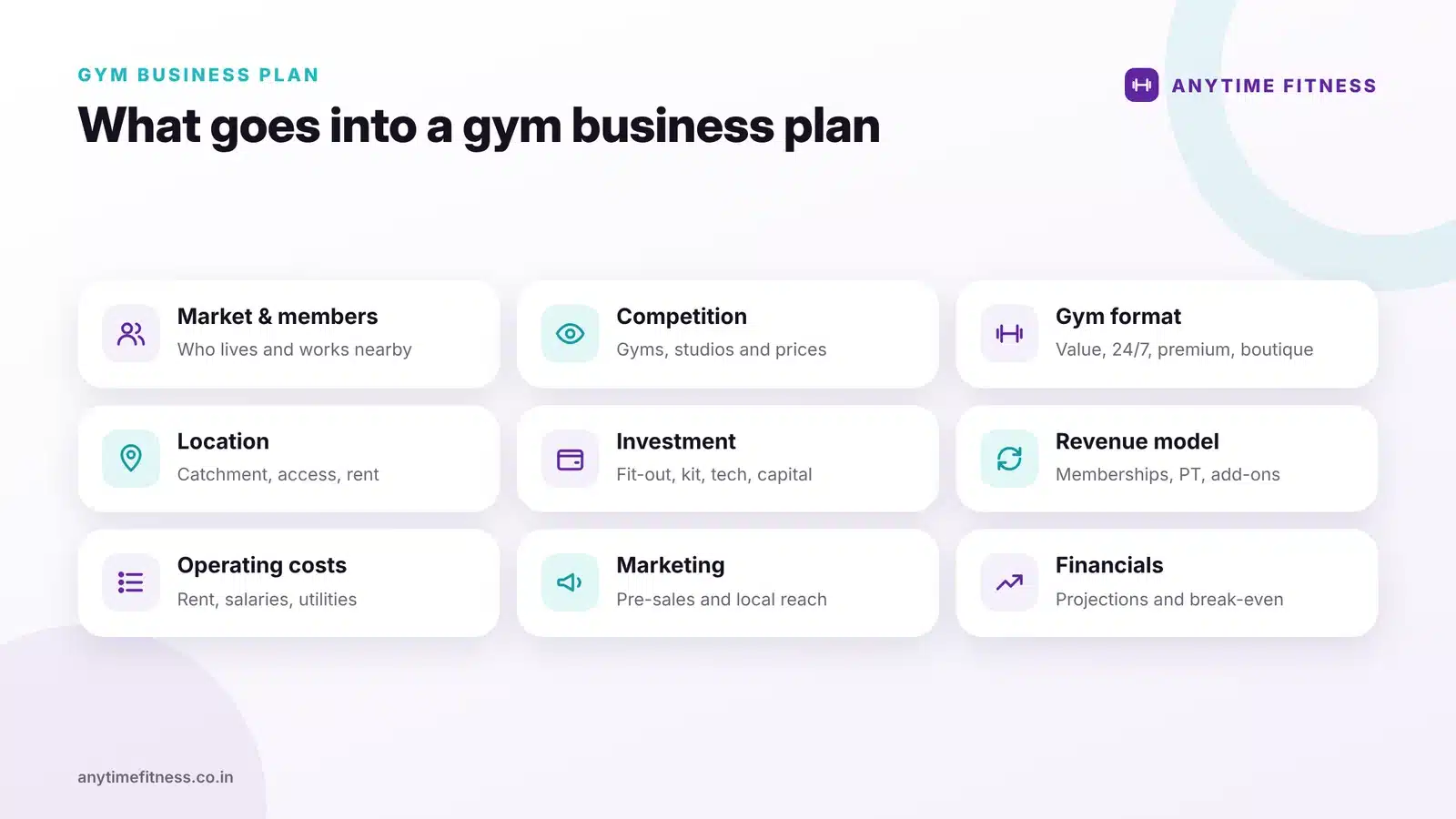
| Section | What it should answer |
|---|---|
| Market and members | Who lives and works nearby, their age and income, and what they want from a gym |
| Competition | Which gyms, studios and apps already serve the area, and at what price |
| Gym format | Value gym, 24/7 club, premium club or boutique studio, and why |
| Location | Catchment, visibility, access, parking and rent |
| Investment | Fit-out, equipment, technology, deposits, pre-opening marketing, working capital |
| Revenue model | Membership plans, enrolment fees, personal training and add-ons |
| Operating costs | Rent, salaries, utilities, maintenance, marketing, software, royalties if franchised |
| Marketing plan | Pre-sales, digital campaigns, local activity and referral programmes |
| Financials | Monthly projections, break-even members and payback period |
Step 1: Choose your gym format
Your format decides your size, budget, pricing and members, so choose it first. In India, value gyms account for about 78% of memberships and 80% of facilities, while boutique studios are growing fastest, at nearly 19% a year through 2030 (Deloitte–HFA, 2025).
| Format | Best for | Watch out for |
|---|---|---|
| Value / mid-market gym | Broad residential catchments, price-conscious members | Thin margins; needs high member volume |
| 24/7 access club | Busy professionals, shift workers, convenience seekers | Needs secure access systems and clear safety processes |
| Premium club | Affluent areas, members who want extra amenities | Large space and high fit-out cost |
| Boutique studio | One discipline (strength, cycling, yoga, HIIT) | Narrower audience; depends on coach quality |
Step 2: Research your market and location
The right location has enough people within a short commute, good visibility and access, and rent your membership revenue can comfortably support. Map residential societies, offices and colleges nearby, then visit every competing gym at peak hours to see how busy they are and what they charge.
- Catchment: how many working-age adults live or work within easy reach?
- Visibility and access: main-road frontage, signage, lift access and parking matter in Indian cities.
- Rent-to-revenue fit: rent is usually your largest fixed cost, so model it against realistic membership numbers.
- Competition: a busy competitor can prove demand; an empty one is a warning.
Metros still dominate. The top 10 cities generate 56% of fitness revenue but hold only 31% of facilities, and growth is expected to reach smaller cities as well (Deloitte–HFA, 2025). Read more in our guide to India’s fitness industry.
Step 3: Plan your investment and funding
Budget for six cost buckets: fit-out, equipment, technology, deposits and rent, pre-opening marketing, and working capital to cover the months before the gym is self-sustaining. Costs vary widely with city, size and format, so get quotes for your specific site rather than relying on averages.
If you follow a franchise route, the brand usually gives you a detailed budget. For example, an Anytime Fitness club in India needs a total initial investment of about ₹3–3.5 crore, with a fixed monthly royalty (Anytime Fitness India). See the full breakdown in how to start a gym franchise business in India.
Step 4: Complete the licences and registrations
Most gyms in India need a registered business entity, Shops and Establishments registration, a municipal health or trade licence, a fire safety NOC, GST registration where applicable, and music licences if they play recorded music. Requirements and names vary by state and municipal corporation, so confirm with your local authority or a professional adviser.
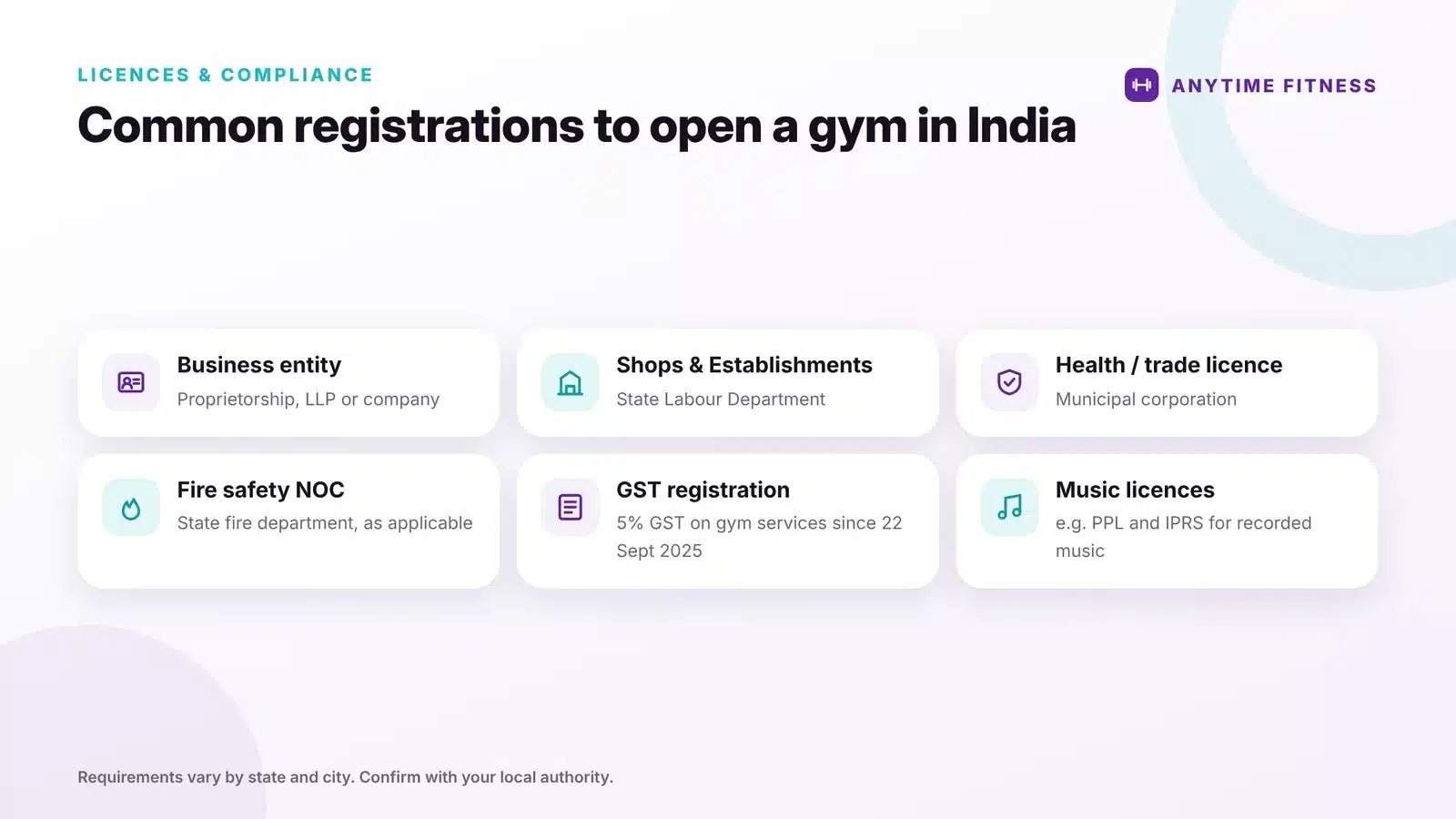
| Registration | Typically issued by | Why it matters |
|---|---|---|
| Business entity (proprietorship, LLP or company) | Registrar of Companies / relevant authority | Legal identity, bank account and contracts |
| Shops and Establishments registration | State Labour Department | Required for commercial premises with employees |
| Health / trade licence | Municipal corporation | Permission to operate the premises |
| Fire safety NOC | State fire department | Often needed depending on size, floor and occupancy |
| GST registration | GST Network (online) | Mandatory above the turnover threshold; gym services attract 5% GST since 22 Sept 2025 |
| Music licences (e.g. PPL, IPRS) | Copyright licensing bodies | Needed to play recorded music publicly |
Step 5: Fit out the space and choose your equipment
Plan the floor around how members actually train: a large strength zone, a cardio zone, a functional area and clean changing rooms. Strength training is in high demand, so prioritise racks, benches, dumbbells and cable machines over rows of identical cardio machines. Add technology for access control, billing and lead management from day one.
Step 6: Build your team
Most gyms need a manager, certified trainers, front-desk or sales staff and housekeeping. Trainers shape the member experience more than any machine, so check certifications and hire for communication as well as technical skill.
Step 7: Set pricing and your revenue model
Recurring monthly memberships should be the core of your revenue, with enrolment fees and personal training on top. Price against local competitors and your format, and reward commitment (quarterly or annual plans) without making monthly plans unattractive. Retention matters more than constant discounting: a member who stays two years is worth far more than two who leave after two months.
How do you calculate a gym’s break-even point?
Break-even members = total monthly fixed costs ÷ average monthly revenue per member. Fixed costs include rent, salaries, utilities, software, loan repayments and any royalty.
Illustrative example only: if your monthly fixed costs are ₹10,00,000 and each member contributes an average of ₹2,500 a month, you need 400 paying members to break even. Use your own quotes and local prices; these are not benchmarks.
Step 8: Pre-sell memberships before you open
Pre-sales let you build a member base and cash flow before launch. Use a sales point at the site, local digital ads, society and corporate tie-ups, and founding-member offers. Start pre-sales once your opening date is reliable.
Independent gym or franchise: which route should you choose?
An independent gym gives full control and no royalty, while a franchise gives a recognised brand, a proven operating system, training and launch support in exchange for fees and brand standards. First-time owners often choose a franchise to reduce the number of things they must figure out alone.
| Factor | Independent gym | Franchise |
|---|---|---|
| Brand | Built from scratch | Recognised from day one |
| Systems and training | Created by you | Provided and ongoing |
| Site and launch support | Self-managed | Usually included |
| Ongoing fees | None | Royalty (fixed or % of sales, depending on brand) |
| Control | Complete | Within brand standards |
Anytime Fitness at a Glance
- 200+ clubs across India
- 6,000+ clubs worldwide
- 24/7 fitness access for members
- Members can access Anytime Fitness clubs worldwide
If you would rather follow a structured model, Anytime Fitness owners receive mandatory training at the corporate office in Delhi, site-selection guidance, FitnessForce gym management software, an online operations manual and pre- and post-launch marketing support, with a fixed monthly royalty rather than a share of sales.
Exploring a structured way to open a gym?
Learn how the Anytime Fitness franchise model works, from site selection to launch.
In summary
Start with your format and location, budget for six cost buckets, complete your city’s registrations, and know your break-even member count before you sign a lease. Whether you go independent or franchise, a written plan is what makes the numbers work.
Frequently asked questions
What licences do I need to open a gym in India?
Most gyms need a registered business entity, Shops and Establishments registration from the state labour department, a health or trade licence from the municipal corporation, a fire safety NOC where applicable, GST registration if turnover crosses the threshold, and music licences (such as PPL and IPRS) to play recorded music. Exact requirements vary by state and city.
What is the GST rate on gym services in India?
GST on gym and fitness centre services was reduced from 18% to 5% with effect from 22 September 2025. Check the current position and input tax credit rules with your tax adviser.
How do I calculate break-even for a gym?
Divide your total monthly fixed costs by the average monthly revenue per member. For example, ₹10 lakh of monthly fixed costs and ₹2,500 average revenue per member means you need about 400 paying members to break even. Use your own figures.
Is a gym business profitable in India?
A gym can be profitable when it is in the right location, priced for its market and good at retaining members, because most revenue is recurring. Profitability depends heavily on rent, staffing costs and member retention, so model these carefully before committing.
Can I start a gym without fitness experience?
Yes. Many gym owners come from other businesses and hire certified trainers and an experienced manager. A franchise can also provide training, operating manuals and ongoing support.
What is the best gym format to start in India?
It depends on your location and budget. Value gyms hold most memberships in India, 24/7 clubs suit busy professionals, and boutique studios are the fastest-growing segment. Match the format to your catchment.
Should I open an independent gym or a franchise?
Choose independent if you have fitness business experience and want full control. Choose a franchise if you want a recognised brand, a tested operating system and launch support, and are comfortable with fees and brand standards.
Sources
- Deloitte India & Health & Fitness Association, India Fitness Market Report 2025
- ClearTax: GST on gym and beauty services (rate cut to 5% from 22 Sept 2025)
- Anytime Fitness India Franchise
- Athletech News: India’s fitness market expected to more than double (Sept 2025)
Last updated: 19 October 2026. This article is for general information and is not medical, financial or legal advice.

 by