
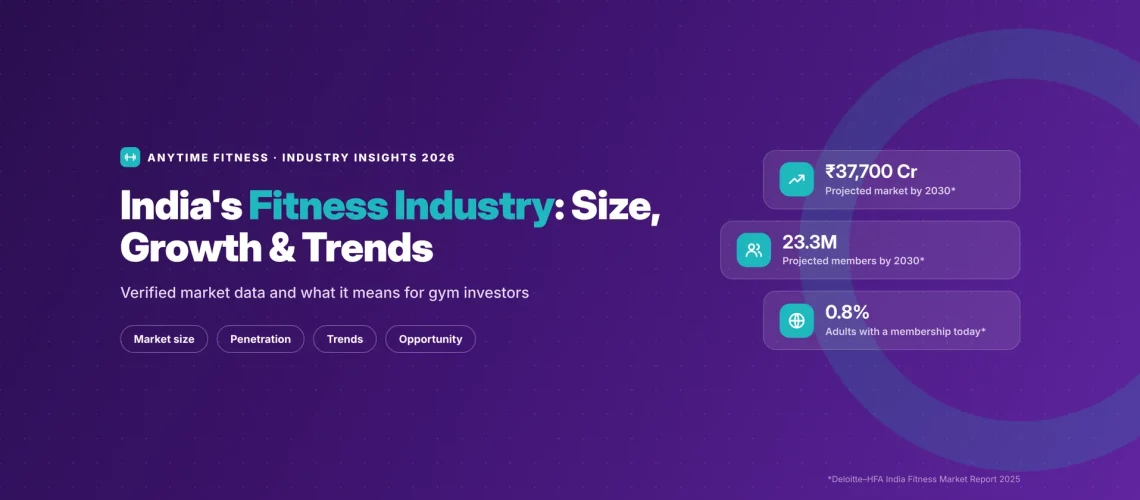
For anyone considering a gym or fitness franchise, the industry’s direction matters as much as any single location. This guide brings together the most recent verified data on India’s fitness market: how big it is, who is joining, where growth is coming from and the challenges operators face.
Key takeaways
- Market size: ₹16,200 crore in 2024, projected ₹37,700 crore by 2030 (about 15% CAGR).
- Members: 12.3 million in 2024, projected 23.3 million by 2030.
- Penetration: about 0.8% of adults today, versus 25% in the US and 17% in the UK.
- Facilities: about 46,500 today, projected 65,500 by 2030.
- Value gyms hold about 78% of memberships; boutique studios are growing fastest at nearly 19% a year.
How big is the fitness industry in India?
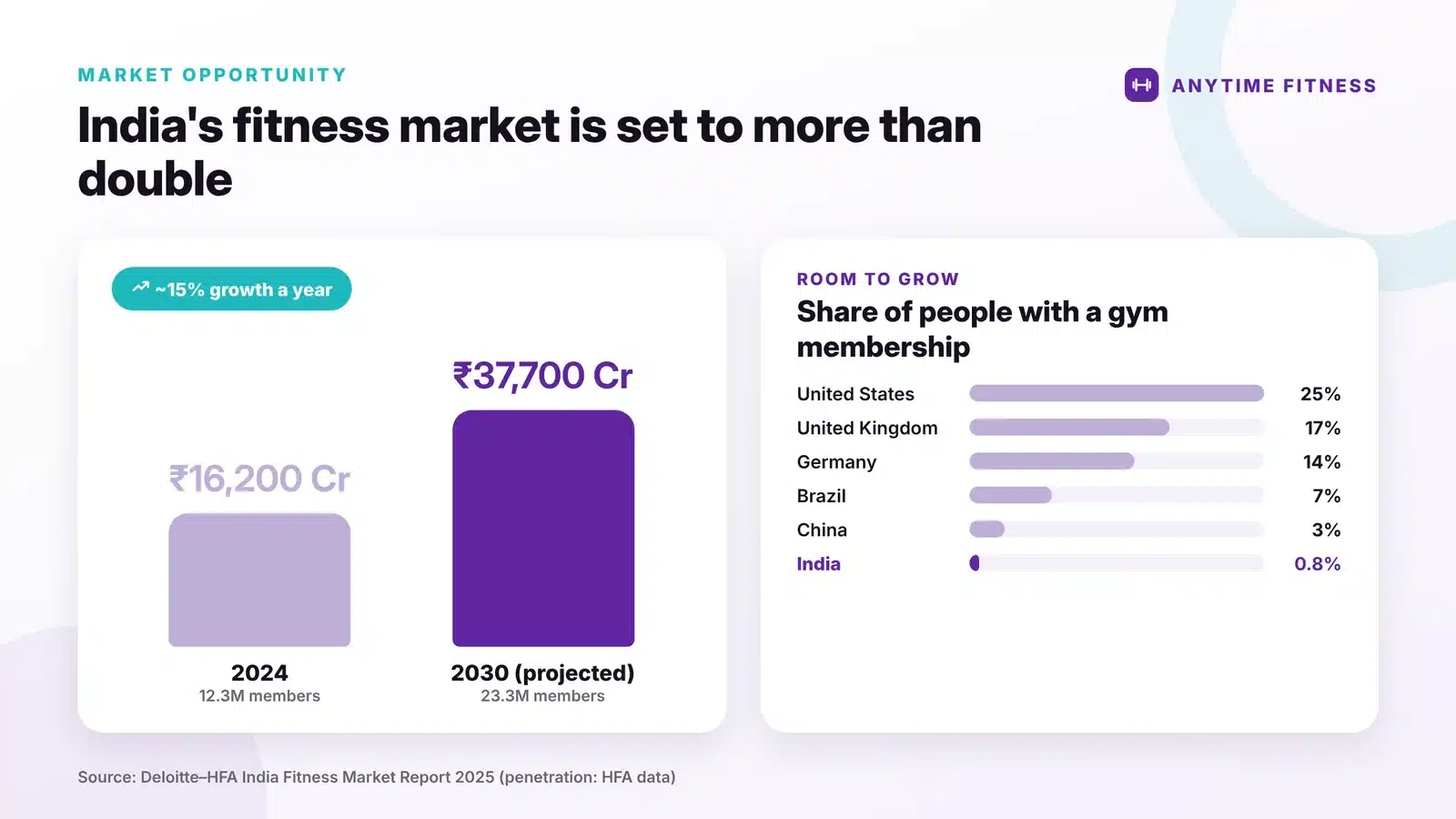
India’s fitness market was worth about ₹16,200 crore in 2024 and is projected to reach about ₹37,700 crore by 2030. That means the market is expected to more than double in six years, according to the India Fitness Market Report 2025 by Deloitte India and the Health & Fitness Association (HFA).
| Metric | 2024 | 2030 (projected) |
|---|---|---|
| Market revenue | ₹16,200 crore (US$1.9 bn) | ₹37,700 crore (US$4.5 bn) |
| Fitness facility members | 12.3 million | 23.3 million |
| Share of adults with a membership | About 0.8% | Above 1.7% |
| Fitness facilities | About 46,500 | About 65,500 |
How does India compare with other countries?
India’s gym membership penetration of about 0.8% is far below mature markets such as the US (25%), UK (17%) and Germany (14%), and below Brazil (7%) and China (3%). Low penetration means much of the future demand is still being created, not just shared among existing gyms.
| Country | Share of population with a club or gym membership |
|---|---|
| United States | 25% |
| United Kingdom | 17% |
| Germany | 14% |
| Brazil | 7% |
| China | 3% |
| India | 0.8% |
Source: HFA data as reported by Athletech News (2025). Comparison years vary by country.
Why is the fitness industry in India growing?
Growth is driven by rising health awareness, a large inactive population, urban working lifestyles and the expansion of organised, branded fitness clubs.
- A large inactive population: about half of Indian adults (49.4% in 2022) did not get enough physical activity, according to a 2024 study in The Lancet Global Health. The Deloitte–HFA report notes that around 820 million Indians aged 18–62 are physically inactive.
- Preventive health: more people see regular exercise as protection against lifestyle diseases.
- Urban, time-poor lifestyles: long commutes and office hours increase demand for convenient, flexible access such as 24/7 clubs.
- Shift to organised gyms: members increasingly expect consistent standards, trained staff and technology.
Which fitness segments are growing fastest?
Value gyms dominate by volume, with about 78% of memberships and 80% of facilities, while boutique studios are the fastest-growing segment at nearly 19% a year through 2030 (Deloitte–HFA, 2025).
What are the key fitness trends in India in 2026?
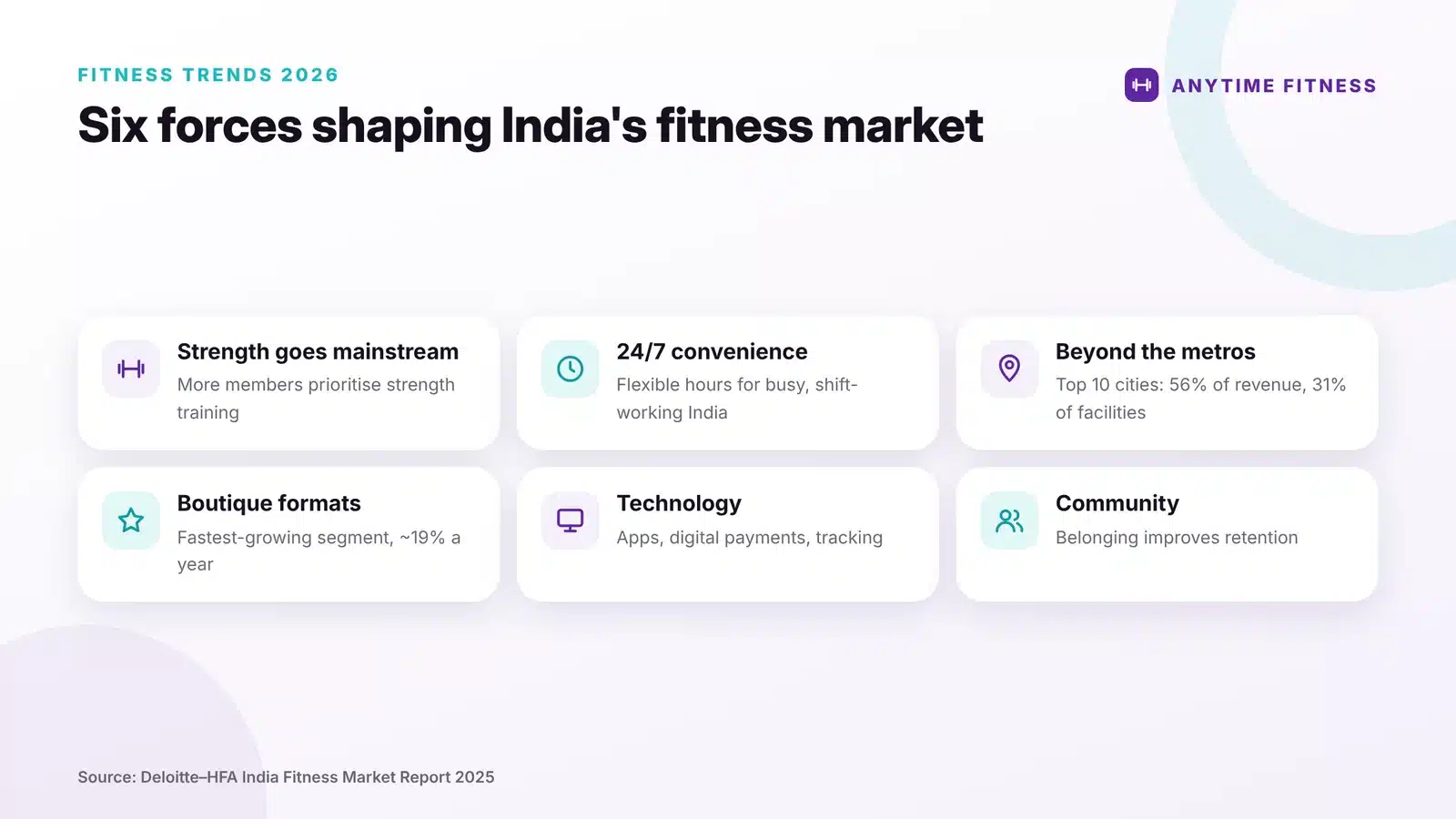
- Strength training goes mainstream: more members, including women and older adults, are prioritising strength over cardio-only routines.
- Convenience and 24/7 access: flexible hours suit shift workers and busy professionals.
- Growth beyond the metros: the top 10 cities earn 56% of revenue but hold only 31% of facilities, and growth is expected to spread to smaller cities.
- Boutique and specialised formats: strength studios, functional training and group classes.
- Technology: app-based bookings, digital payments and member tracking.
- Community: members stay longer when they feel part of a group.
What challenges does India’s fitness industry face?
- Retention: keeping members beyond the first few months is the biggest operational challenge.
- Real estate costs: rent in prime urban locations can squeeze margins.
- Price sensitivity: many consumers compare on price first, which favours efficient operators.
- Talent: finding and keeping qualified trainers.
- Unorganised competition: many small independent gyms compete on price.
What does this mean for gym investors and franchise owners?
Low penetration and steady growth create room for well-run, well-located gyms, especially organised operators with proven systems. Investors should focus on location, member retention and cost control, and consider whether a franchise model can reduce start-up risk. Our step-by-step gym business plan and gym franchise guide cover the practical side.
About Anytime Fitness India
Anytime Fitness is a global fitness club brand with more than 6,000 clubs worldwide and 200+ clubs across India. Its clubs offer members 24/7 access, and the brand grows through a franchise model in which local owners run clubs with the support of the Anytime Fitness system.
Want to be part of India’s fitness growth?
Explore the Anytime Fitness franchise opportunity and see how the model works.
In summary
India’s fitness market is projected to grow from ₹16,200 crore to ₹37,700 crore between 2024 and 2030, with memberships nearly doubling. Penetration is still under 1% of adults, so the opportunity is large, but success depends on location, retention and operational discipline.
Frequently asked questions
What is the size of the fitness industry in India?
India’s fitness industry generated about ₹16,200 crore (US$1.9 billion) in 2024, according to the Deloitte–HFA India Fitness Market Report 2025. It is projected to reach about ₹37,700 crore (US$4.5 billion) by 2030.
How fast is the Indian fitness market growing?
The market is projected to grow at roughly 15% a year between 2024 and 2030, more than doubling in size over that period.
How many people in India have a gym membership?
About 12.3 million Indians held a fitness facility membership in 2024, roughly 0.8% of adults. This is projected to rise to 23.3 million, or above 1.7% of adults, by 2030.
Which fitness segment is growing fastest in India?
Boutique studios are the fastest-growing segment, expected to grow at nearly 19% a year through 2030. Value gyms remain the largest segment, with about 78% of memberships.
Is the gym business a good investment in India?
India’s low penetration and projected growth create a strong long-term opportunity, but returns depend on location, pricing, member retention and costs. Many first-time investors use franchise models to reduce start-up risk.
Why is India’s gym penetration so low?
Factors include affordability, limited organised supply in smaller cities, and the fact that regular gym-going is still a relatively new habit for many Indians. Around half of Indian adults are not sufficiently active.
Which cities lead India’s fitness market?
The top 10 cities, including Mumbai, Delhi NCR and Bengaluru, generate about 56% of fitness revenue while holding about 31% of facilities, according to Deloitte–HFA.
Sources
- Deloitte India & Health & Fitness Association, India Fitness Market Report 2025
- Athletech News: India’s fitness market expected to more than double (Sept 2025)
- Strain T. et al. (2024). National, regional and global trends in insufficient physical activity. Lancet Global Health
- Anytime Fitness India Franchise
Last updated: 19 October 2026. This article is for general information and is not medical, financial or legal advice.

 by