
Walking into a gym for the first time can feel overwhelming: dozens of machines, people who seem to know exactly what they’re doing, and conflicting advice everywhere. The good news is that beginners don’t need complicated splits. A simple, repeatable full-body plan builds strength, confidence and technique faster than chasing variety.
Key takeaways
- Train full body 3 times a week, with at least one rest day between sessions.
- Alternate two workouts (A and B) so each muscle group is trained two or three times a week.
- Start with 1–2 sets of 8–12 reps and build to 3 sets by week 4, in line with ACSM guidance for novices.
- WHO recommends 150–300 minutes of moderate activity a week plus muscle-strengthening on 2 or more days.
- Progress by adding a rep or a small amount of weight when all sets feel controlled.
How many days a week should a beginner go to the gym?
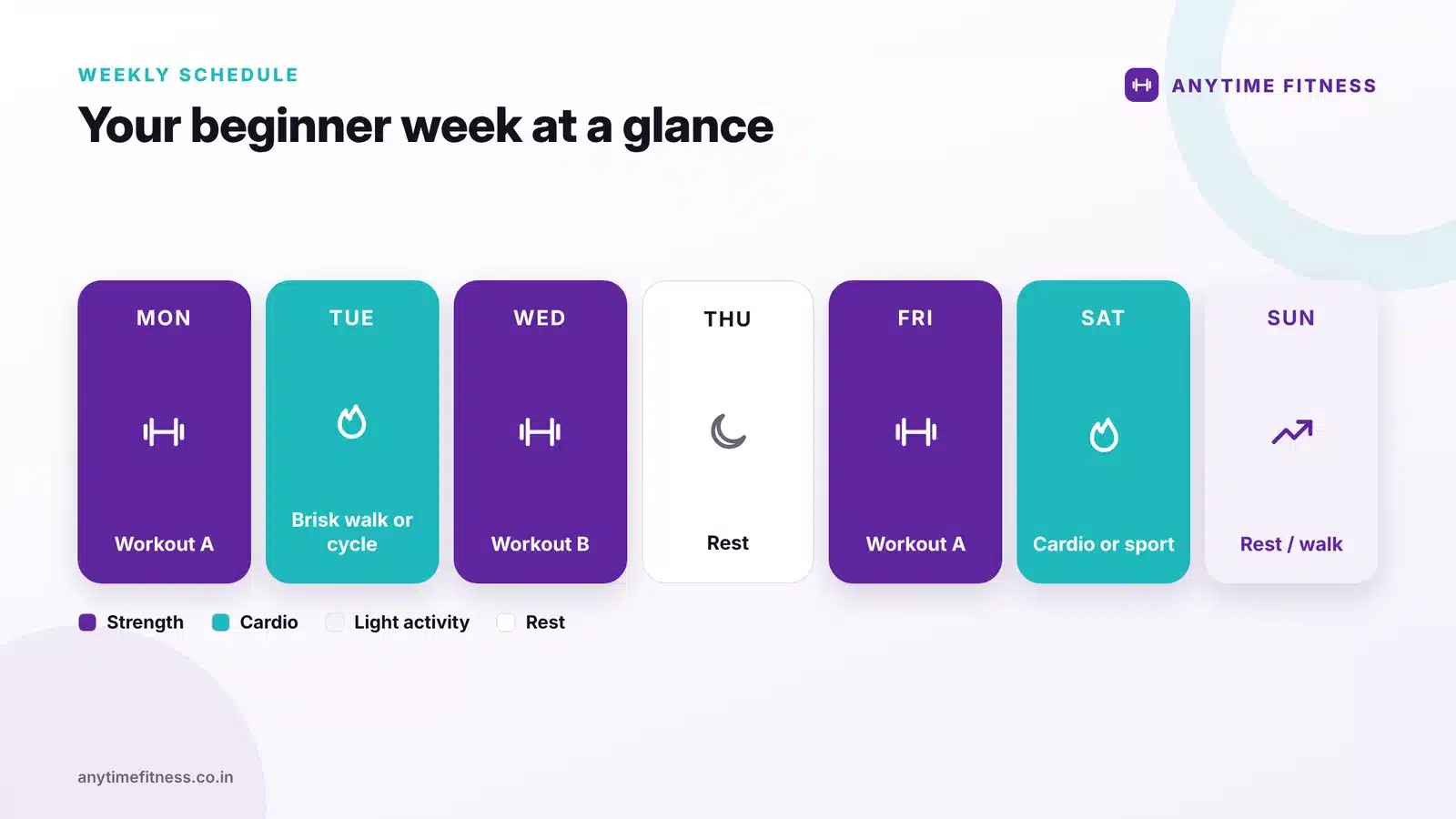
Three days a week is ideal for most beginners. It gives each muscle group enough training to improve while leaving 48 hours to recover. The World Health Organization recommends muscle-strengthening activity on two or more days a week, plus 150–300 minutes of moderate aerobic activity, so three strength days plus some walking or cycling covers both.
The 4-week beginner plan at a glance
| Week | Sets × reps | Focus |
|---|---|---|
| Week 1 | 1–2 sets × 10–12 reps | Learn each movement with light weights; leave 3–4 reps in reserve |
| Week 2 | 2 sets × 10–12 reps | Same exercises; add a little weight if form stays solid |
| Week 3 | 2–3 sets × 8–12 reps | Add a third set to the main lifts; rest 60–90 seconds |
| Week 4 | 3 sets × 8–10 reps | Slightly heavier; finish sets with 2–3 reps in reserve |
Workout A and Workout B
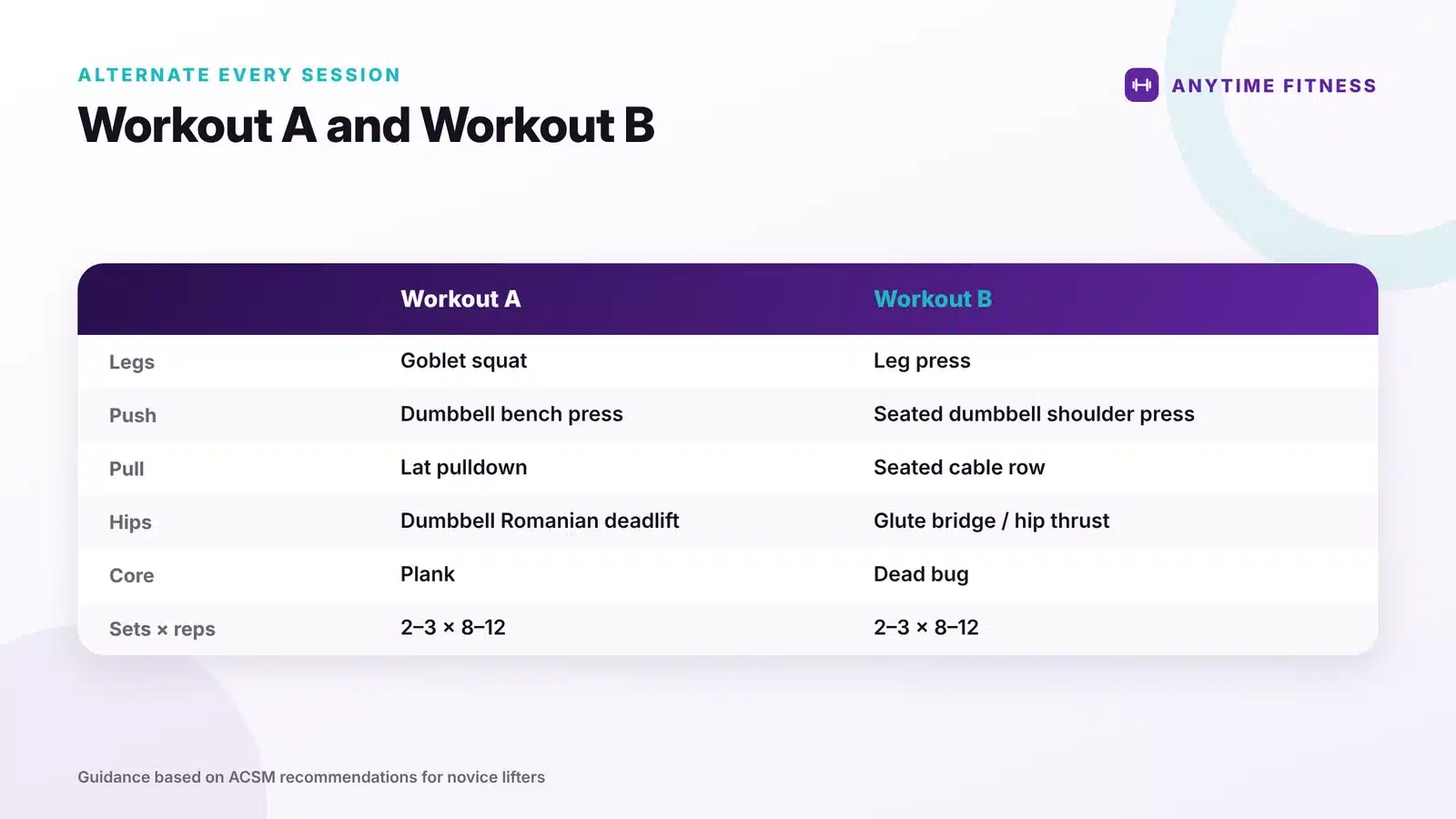
Alternate the two workouts: A–B–A one week, B–A–B the next. Each covers legs, a push, a pull, the hips and the core. Machine or dumbbell alternatives are listed if the main option is busy or you’re not yet comfortable with it.
| Workout A | Sets × reps | Alternative |
|---|---|---|
| Goblet squat | 2–3 × 8–12 | Leg press |
| Dumbbell bench press | 2–3 × 8–12 | Push-ups (hands on bench) |
| Lat pulldown | 2–3 × 8–12 | Assisted pull-up machine |
| Dumbbell Romanian deadlift | 2–3 × 8–12 | Hip hinge with kettlebell |
| Plank | 2–3 × 20–40 sec | Knee plank |
| Workout B | Sets × reps | Alternative |
|---|---|---|
| Leg press | 2–3 × 10–12 | Bodyweight box squat |
| Seated dumbbell shoulder press | 2–3 × 8–12 | Machine shoulder press |
| Seated cable row | 2–3 × 8–12 | Chest-supported dumbbell row |
| Glute bridge or hip thrust | 2–3 × 10–12 | Floor glute bridge |
| Dead bug | 2–3 × 8 per side | Bird dog |
Warm-up and cool-down
- Warm-up (5–8 minutes): easy cycling or brisk walking, then bodyweight squats, arm circles and a light first set of each exercise.
- Cool-down (3–5 minutes): slow walking and gentle stretches for hips, chest and back.
How much weight should a beginner lift?
Choose a weight you can lift for the target reps with good form while stopping with 2–3 reps still in reserve. If the last rep is slow and form breaks down, it’s too heavy; if you could do 5 more, it’s too light. Start lighter than you think, because learning technique is the priority in the first month.
What is progressive overload and how do beginners use it?
Progressive overload means gradually asking your muscles to do a little more over time, by adding reps, sets or weight. It is the main principle behind getting stronger. A simple method: once you can complete all sets at the top of the rep range with good form, add the smallest weight increment next session and drop back to the lower end of the range.
How much cardio should beginners do?
Aim for about 150 minutes of moderate cardio across the week, such as brisk walking, cycling or the cross-trainer. You can do 10–15 minutes after strength sessions and longer walks on non-gym days. If your goal is weight loss, see our guide to cardio vs strength training for weight loss.
Common beginner mistakes to avoid
- Changing the routine every week instead of repeating it long enough to progress.
- Lifting too heavy too soon and sacrificing form.
- Skipping the warm-up.
- Training the same muscles hard on consecutive days.
- Ignoring sleep and protein. Recovery is where progress happens. See our guide to high-protein vegetarian foods.
Fitting the plan around an Indian work week
Evening slots between 6 and 9 pm are usually the busiest in city gyms, which can make a beginner plan hard to follow when equipment is taken. Early mornings, late evenings or weekend mornings are often quieter. If your hours are unpredictable, a gym with longer or round-the-clock access, such as a 24/7 gym, can make consistency easier.
Check with a doctor before starting if you have a heart condition, high blood pressure, diabetes, an injury, are pregnant, or have been inactive for a long time. Stop any exercise that causes pain, dizziness or chest discomfort.
Ready to start training?
Find out how Anytime Fitness clubs support beginners with 24/7 access and coaching.
In summary
Train full body three times a week, alternate Workouts A and B, build from 1–2 to 3 sets over four weeks, and add weight only when form is solid. Pair it with daily movement, enough protein and sleep, and repeat the plan for at least 4–8 weeks before changing it.
Frequently asked questions
What is the best gym workout plan for beginners?
A full-body plan done three times a week works best for most beginners. Alternate two workouts that each include a squat or leg press, a push, a pull, a hip hinge and a core exercise, using 1–3 sets of 8–12 reps.
How many days a week should a beginner work out?
Three non-consecutive days of strength training is ideal, plus light activity such as walking on other days. WHO recommends muscle-strengthening on at least two days a week.
How long should a beginner gym workout be?
About 45–60 minutes, including a 5–8 minute warm-up, around 30–40 minutes of strength work and a short cool-down.
Should beginners use machines or free weights?
Both are useful. Machines make it easier to learn a movement pattern safely, while dumbbells build coordination. This plan mixes both.
Is muscle soreness after the first workout normal?
Yes. Delayed onset muscle soreness usually appears 24–72 hours after a new workout and eases within a few days. Keep the next sessions light and it reduces as your body adapts. Sharp or joint pain is different and should be checked.
When should I change my beginner workout routine?
Repeat the same plan for at least 4–8 weeks while you keep adding reps or weight. Change it when progress stalls or you have mastered the movements.
Do I need a personal trainer as a beginner?
Not necessarily, but a few sessions with a qualified trainer can help you learn technique, set the right weights and build confidence faster.
Sources
- World Health Organization: Physical activity recommendations
- WHO 2020 guidelines on physical activity and sedentary behaviour
- ACSM Position Stand (2009): Progression models in resistance training for healthy adults
Last updated: 19 October 2026. This article is for general information and is not medical, financial or legal advice.

 by