
Most people don’t stop going to the gym because they lack willpower. They stop because life gets busy, a week gets missed, and restarting feels harder than starting. The people who stay fit for years usually aren’t the most motivated; they’ve made training a default part of their week.
✎ Member spotlight (editor: replace before publishing)
- [Insert verified member story here: first name, city, club and how long they’ve been training (with written consent)]
- A moment when motivation dropped, and what kept them going
- The routine or habit that made the difference (time slot, training partner, trainer, tracking)
- What has changed beyond the scale: energy, strength, sleep, confidence (avoid unverified numbers)
Use only real, verified member information with written consent. Delete this box if no story is available yet.
Key takeaways
- Motivation starts the habit; routine and environment keep it going.
- Habit formation takes time: a median of 66 days in Lally et al. (2010), ranging from 18 to 254 days.
- Missing a single day did not significantly affect habit formation in that study, so one missed session isn’t failure.
- Fixed training slots and small, achievable sessions beat occasional heroic workouts.
- Track strength, energy, sleep and consistency, not only weight.
Why does fitness motivation fade?
Motivation is an emotion, and emotions fluctuate with stress, sleep, work and mood. It is usually highest at the start (a new year, a new membership, an upcoming wedding or a festive-season goal) and drops once the novelty wears off and results feel slow. That’s normal. The fix isn’t more motivation; it’s a system that works on low-motivation days.
Motivation, discipline and habit: what’s the difference?
| What it is | How long it lasts | Role in fitness | |
|---|---|---|---|
| Motivation | The desire to act | Fluctuates day to day | Gets you started |
| Discipline | Acting despite low desire | Limited; can be tiring | Bridges tough days |
| Habit | Automatic behaviour triggered by a cue | Long-lasting once formed | Keeps you going for years |
How long does it take to build a workout habit?
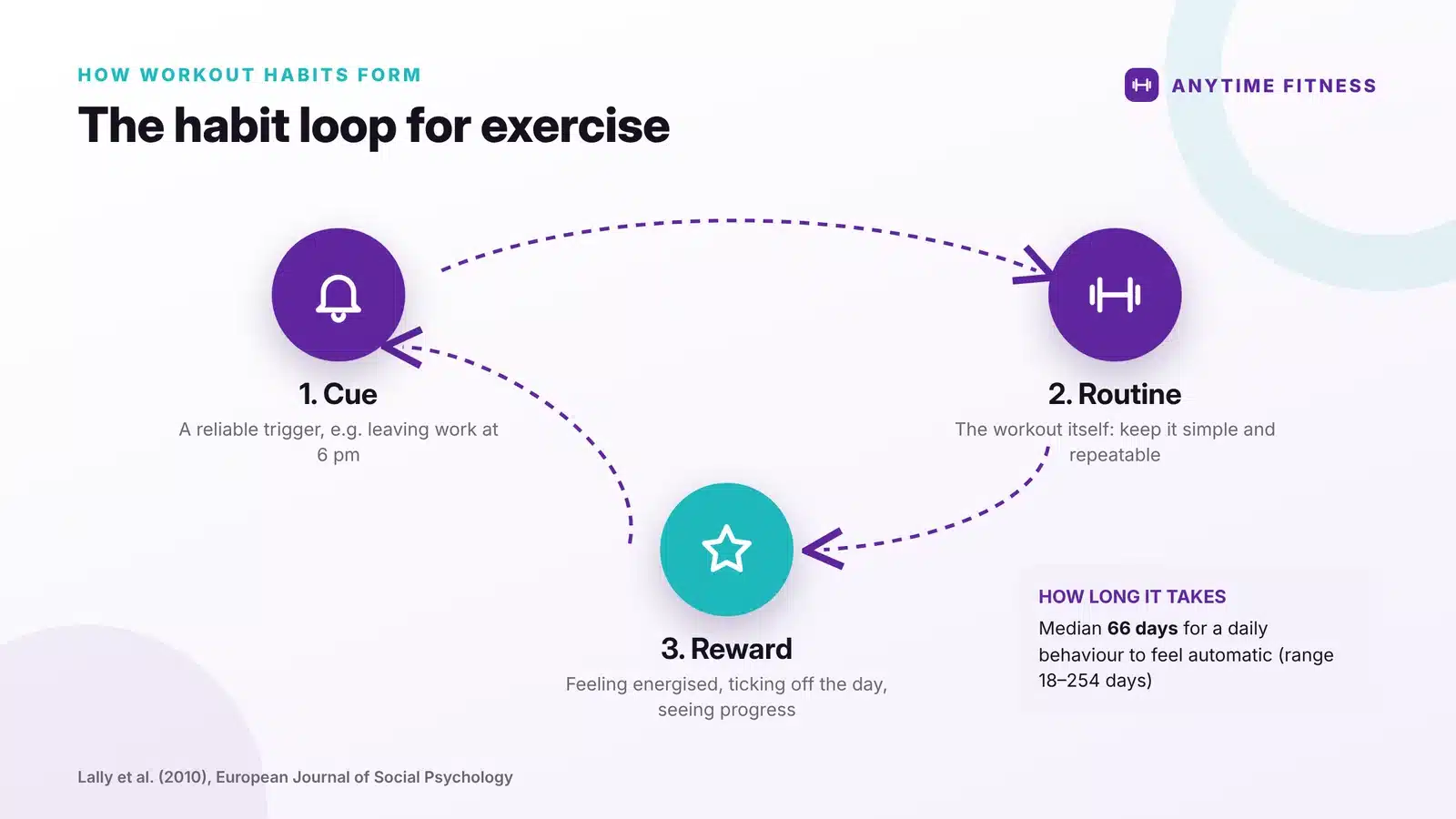
There is no fixed number, but research suggests weeks to months rather than days. In a study by Lally and colleagues at University College London, it took participants a median of 66 days for a new daily behaviour to become automatic, with individual times ranging from 18 to 254 days. Missing an occasional day did not significantly affect the process. More complex behaviours, like exercise, often take longer than simple ones.
8 ways to stay consistent with exercise
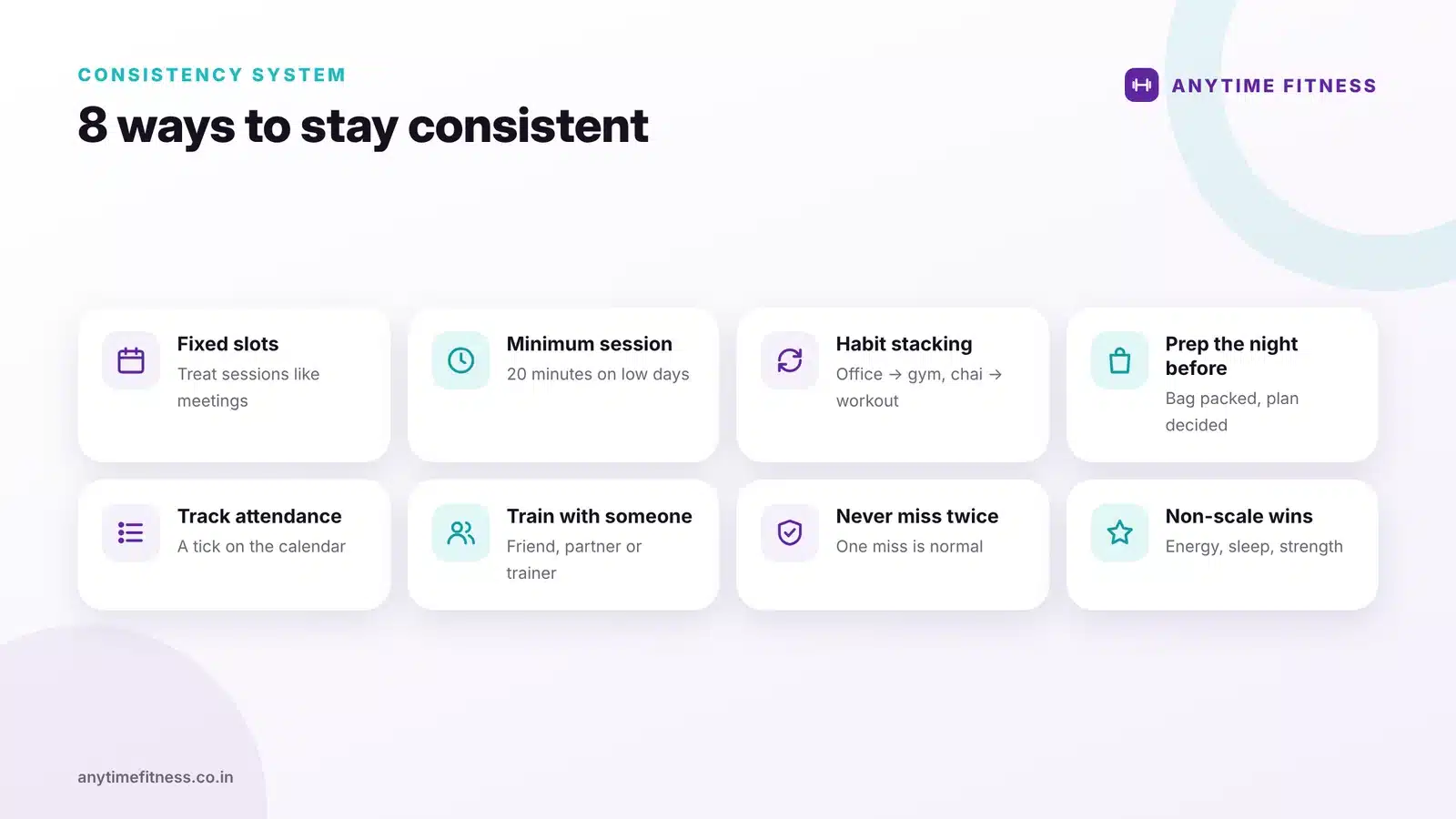
- Schedule fixed slots. Treat two or three weekly sessions like meetings.
- Set a minimum session. On low days, commit to just 20 minutes; you’ll often do more.
- Stack it onto an existing habit. For example, go straight from office to gym before the commute home, or train right after morning chai.
- Prepare the night before. Pack your bag and decide the workout in advance.
- Track attendance. A simple calendar tick builds momentum.
- Train with someone. A friend, partner or trainer adds accountability.
- Never miss twice. One missed session is normal; two in a row is where habits slip.
- Celebrate non-scale wins. More energy, better sleep, heavier lifts and clothes fitting better all count.
In India, the usual disruptors are predictable: festive seasons, weddings, exam or appraisal periods, travel and monsoon commutes. Plan for them in advance, for example with shorter sessions or home workouts during those weeks, rather than stopping completely.
How to get back to the gym after a long break
Restart lighter and shorter than where you left off, rebuild the routine first and the intensity second. Expect some soreness in the first week back and progress over a few weeks. Our 4-week beginner plan works well as a restart programme.
- Use lighter weights and fewer sets for the first one or two weeks.
- Book your first three sessions in advance.
- Focus on attendance before performance.
- If you’ve had an injury, illness or surgery, get medical clearance first.
How to track progress beyond the scale
| What to track | How |
|---|---|
| Consistency | Sessions completed per week |
| Strength | Weights and reps for 3–4 main exercises |
| Fitness | Time or distance for a set cardio session |
| Body measurements | Waist and hips once every 2–4 weeks |
| Wellbeing | Energy, sleep and mood, noted weekly |
✎ In our members’ words (editor: replace before publishing)
- [Insert verified member quote here: the one habit that kept them consistent]
- [Optional: a verified milestone such as 100 sessions or a first pull-up, with consent]
Use only real, verified member information with written consent. Delete this box if no story is available yet.
Where community and environment help
Your environment makes consistency easier or harder. A gym close to home or work, open when you’re free, and a friendly community all reduce friction. Anytime Fitness clubs give members 24/7 access, so a late meeting or early start doesn’t have to mean a missed workout.
Building your routine?
Find an Anytime Fitness club with 24/7 access that fits your schedule.
In summary
Don’t wait for motivation. Build a system: fixed slots, a minimum session, a cue, a tracker and a simple rule to never miss twice. Give it weeks to months, and judge progress by consistency, strength and energy as well as the scale.
Frequently asked questions
How do I stay motivated to go to the gym?
Rely on habits rather than motivation: schedule fixed sessions, set a minimum workout for low-energy days, train with someone and track attendance. Motivation follows action more often than the other way round.
How long does it take to form a gym habit?
It varies. In one study, a new daily behaviour took a median of 66 days to become automatic, ranging from 18 to 254 days. Exercise habits may take longer, so stick with it for a few months.
What should I do when I have no motivation to work out?
Commit to a minimum session, such as 20 minutes or just your warm-up and one exercise. Starting is usually the hardest part, and you’ll often do more once you begin.
How many days a week should I work out to stay consistent?
Two to four sessions a week is sustainable for most people. Pick days you can repeat every week rather than an ambitious plan you can’t keep.
How do I get back to the gym after a long break?
Start lighter and shorter than before, focus on attendance for the first few weeks, and build intensity gradually. Get medical clearance if the break was due to illness or injury.
What are non-scale victories?
Signs of progress other than weight, such as lifting heavier, more energy, better sleep, improved mood, better stamina and clothes fitting differently.
Is it okay to miss a workout?
Yes. Missing a single session is normal and doesn’t undo progress. Try not to miss two in a row so the routine stays intact.
Sources
- Lally P. et al. (2010). How are habits formed: modelling habit formation in the real world. Eur J Soc Psychol
- World Health Organization: Physical activity recommendations
- WHO 2020 guidelines on physical activity and sedentary behaviour
Last updated: 19 October 2026. This article is for general information and is not medical, financial or legal advice.

 by